


2026年11月4日
Solar Carports Are Sweeping Europe in 2026
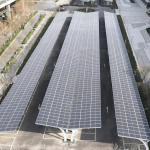
Walk through any big retail parking lot in France, Germany, or Belgium and you’ll notice the sky above the cars is no longer empty. Steel canopies bristling with photovoltaic modules have quietly become one of the fastest-growing structures on the continent. This is the solar carport boom — and it isn’t driven by aesthetics. It’s driven by law, economics, and electric vehicles.
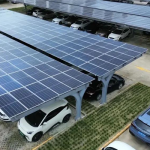
A solar carport is a freestanding canopy whose roof is made of solar panels, generating electricity while sheltering parked vehicles. Once considered a niche alternative to rooftop solar, carports have moved to the European mainstream almost overnight. Here’s why the trend is accelerating in 2026, what it costs, and whether a carport solar system makes sense for your home or business.
From Niche to Mandate: What’s Fueling the European Solar Carport Wave
France put solar carports into the law books
The clearest signal came from France. Under Decree No. 2024-1023, implementing the 2023 APER renewable energy acceleration law, outdoor parking areas larger than 1,500 m² must cover at least 50% of their surface — driving lanes included — with solar canopies or green roofs. The deadlines are concrete:
- Parking lots over 10,000 m²: solar carports required by July 1, 2026
- Parking lots of 1,500–10,000 m²: deadline of July 2, 2028
- Non-compliance penalty: up to €40,000 per year until the obligation is met
The National Assembly passed an amendment in May 2025 easing some thresholds, but the direction of travel is unmistakable: in France, a solar carport has shifted from a green investment to a legal requirement for thousands of commercial sites.
The EU’s EPBD makes “solar-ready” the new normal
France isn’t alone. The revised EU Energy Performance of Buildings Directive (EPBD) introduced the “EU Solar Rooftop Initiative”: member states must transpose the solar standard into national law by May 2026, with phased mandates for new public and non-residential buildings from 2027, heavily renovated non-residential buildings from 2028, and new residential buildings by 2030. Several German states already layer their own parking-space rules on top, and the UK government ran a 2025 evidence consultation on mandating solar canopies for new car parks — an outcome the industry is still waiting for.
The market data backs it up
Fortune Business Insights values the European solar carport market at roughly USD 222 million in 2024, projected to reach USD 484 million by 2032 — about 10% CAGR. That growth sits on the back of a broader boom: the EU installed 65.1 GW of new solar PV in 2025, and SolarPower Europe expects around 68 GW in 2026. Parking lots are Europe’s largest under-used “solar surface,” and both regulators and developers have noticed.
Solar Carport vs. Rooftop Solar: Which Wins in 2026?
| Factor | Solar carport | Rooftop solar |
| Capital cost | Higher (~£1.50–£2.00/W DC for commercial systems in the UK; structural steel adds ~60% over rooftop) | Lower (~£0.80–£1.20/W DC commercial; EU residential ~€1.20–€1.70/kWp turnkey in many markets) |
| Roof condition required | None — freestanding, no roof penetrations | Needs a sound, correctly oriented roof |
| Added utility | Vehicle shelter: snow, hail, UV protection | None |
| EV charging integration | Ideal — run conduit under the canopy | Often requires separate trenching |
| Space consumed | Active parking area | Unused roof area |
| Typical strength | Legal compliance for mandated lots, retrofit flexibility | Best ROI when roof space is free anyway |
The honest answer: if you have a usable roof, rooftop solar still delivers a faster payback. But a huge share of European parking — shopping centers, factories, corporate HQs, schools, zoos (Belgium’s Pairi Daiza built a 20 MW, 62,750-panel carport once crowned the world’s largest) — has no roof at all. For that space, the solar carport is not competition with rooftop PV; it’s the only way to monetize asphalt. And for owners of damaged, asbestos-covered, or shaded roofs, a carport sidesteps re-roofing costs entirely.
Solar Carport Cost in Europe: What to Budget in 2026
Realistic ranges depend on scale and ground conditions:
- Residential single/double carport (5–10 kWp): commonly €12,000–€30,000 installed in Western Europe, more in Scandinavia where labor and snow-load engineering drive prices up. European residential solar CAPEX broadly runs €1,200–€2,200/kWp, and carports sit at the upper end because you’re paying for structure and array.
- Commercial lots (50–500 kWp): around €1,000–€1,600/kWp, per Solar Data Atlas’s 2026 segment benchmarks; large PPA-funded projects go lower.
- Payback: typically 8–12 years for self-consumption commercial systems in high-price markets (German industrial electricity runs €0.14–€0.16/kWh), shorter when the carport replaces a canopy you had to build anyway, or when compliance was mandatory in the alternative.
Incentives that tilt the math
At least nine European countries have cut VAT on solar panels and installation — the UK charges 0% VAT on solar equipment, and Germany, France, and Italy offer various income tax deductions, KfW-style loans, and EU-funded national aid programs (Italy alone has EU-approved schemes spanning €7.5 billion for business green transitions and a €17.7 billion storage aid package running to 2033). Commercial owners can also skip upfront cost entirely with Power Purchase Agreements: a developer finances and owns the carport, you buy the cheap electricity for 15–20 years. Nearly 19 GW of European renewables were contracted this way in 2024 — carports are increasingly part of that pipeline.
Beyond the Law: Three Reasons Homeowners and Businesses Choose Carports Anyway
- EV charging synergy. A solar carport with an integrated wallbox lets an electric car refuel on sunshine generated meters away — the most direct “sun-to-wheel” story in clean tech. UK DESNZ modelling highlights export, PPA, and direct-wire revenues for car-park PV as a growing business case.
- Asset protection. In a continent of hailstorms, falling pine needles, and ice, a canopy cuts paint damage and de-icing hassle. That shelter value quietly subtracts from the carport’s real cost.
- Grid relief and storage. Pairing a carport with a battery is increasingly common: at Intersolar Europe 2026, hybrid PV-plus-storage designs were the flagship theme, and carports offer ideal mounting for both panels and wall-mounted batteries in plant rooms below.
Planning a Solar Carport: 5 Steps to Get It Right
- Check the obligation and permits first. In France, confirm your lot’s size threshold and any exemption (technical, safety, or heritage grounds). Elsewhere, building permits for freestanding structures vary by municipality.
- Run a structural + geotechnical assessment. Wind uplift, snow load, and soil bearing capacity decide foundation type — screw piles, concrete pads, or ballast.
- Design for cars and electrons together. Standard heights clear roof racks; plan conduit for future chargers from day one — retrofitting trenching is the classic regret.
- Model revenue on real consumption. Self-consumption offsets beat feed-in tariffs almost everywhere in Europe now; size the array to your daytime load plus charging demand.
- Choose O&M early. Canopies collect pollen, bird droppings, and road grime faster than roofs. Annual cleaning and thermal checks protect the 25-year yield assumption in every quote.
FAQ
Is a solar carport worth it compared to rooftop solar?
Rooftop solar still has a lower cost per watt. A solar carport wins when roof space is unusable, when parking areas are legally mandated (France), or when the shelter structure was needed anyway — that dual-purpose accounting flips the economics.
Rooftop solar still has a lower cost per watt. A solar carport wins when roof space is unusable, when parking areas are legally mandated (France), or when the shelter structure was needed anyway — that dual-purpose accounting flips the economics.
How much does a solar carport cost in Europe?
Roughly €12,000–€30,000 for a residential 5–10 kWp system, and €1,000–€1,600/kWp for commercial arrays, before incentives. VAT is 0% in the UK and reduced in at least nine other European countries.
Roughly €12,000–€30,000 for a residential 5–10 kWp system, and €1,000–€1,600/kWp for commercial arrays, before incentives. VAT is 0% in the UK and reduced in at least nine other European countries.
Is a solar carport mandatory in France?
Yes for parking areas over 1,500 m², with staged deadlines of July 1, 2026 (lots above 10,000 m²) and July 2, 2028 (smaller covered lots). A 2025 amendment relaxed parts of the decree, but exemptions are narrow and fines reach €40,000 per year.
Yes for parking areas over 1,500 m², with staged deadlines of July 1, 2026 (lots above 10,000 m²) and July 2, 2028 (smaller covered lots). A 2025 amendment relaxed parts of the decree, but exemptions are narrow and fines reach €40,000 per year.
Can a solar carport charge an electric car?
That’s its best use case. Panels feed a carport-integrated EV charger directly; add storage and the same canopy keeps topping up the car after sunset.
That’s its best use case. Panels feed a carport-integrated EV charger directly; add storage and the same canopy keeps topping up the car after sunset.
The Bottom Line
Europe’s parking lots are becoming power plants by legislation, by economics, or by both. A solar carport is no longer a curiosity — it’s the compliance answer for French retailers, the space strategy for German factories, and the EV pairing play for households from Rotterdam to Rome. If you manage a parking area anywhere on the continent, 2026 is the year to stop calling it empty space.